
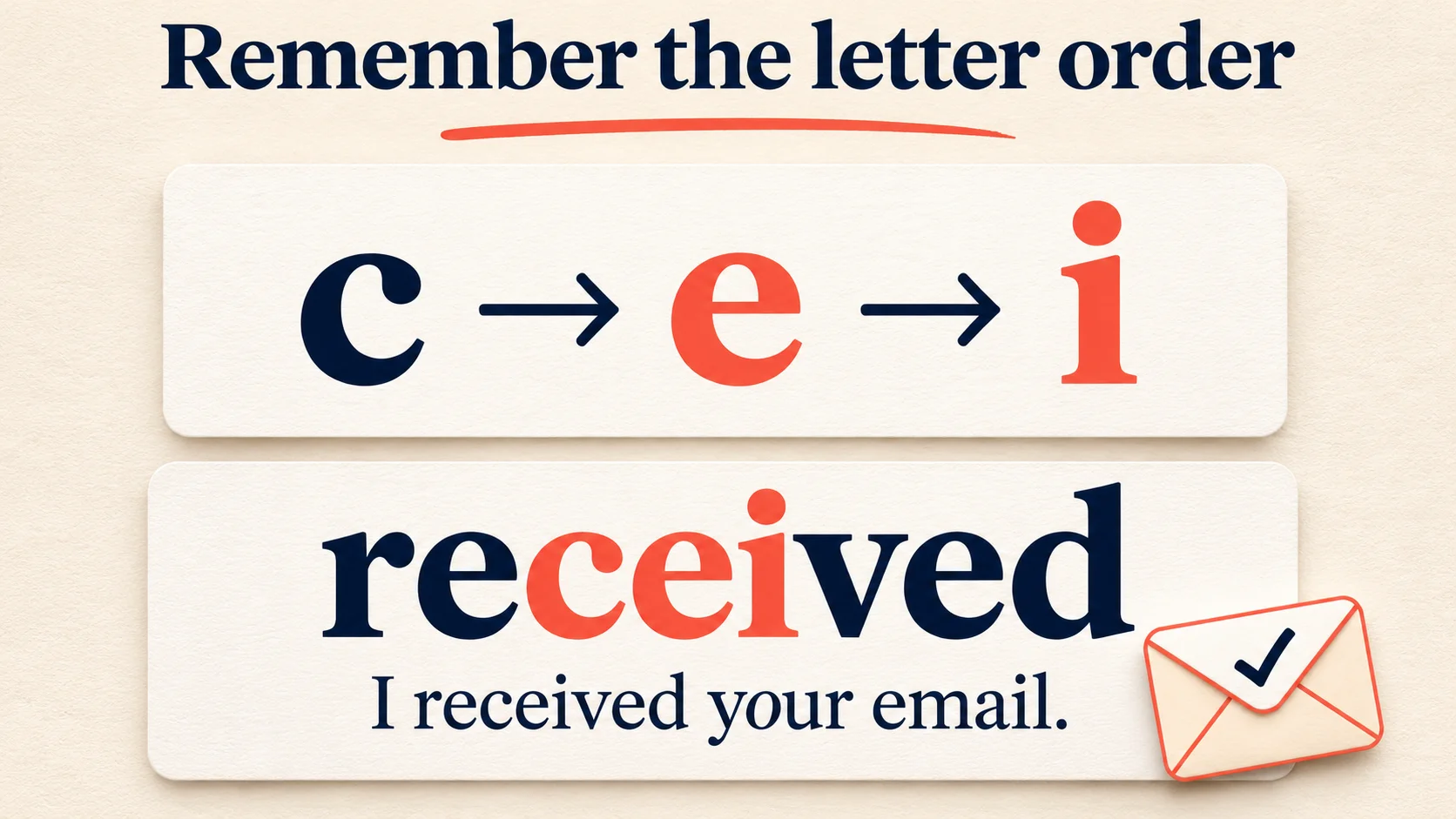
Received is the correct spelling. The version recieved reverses the middle vowels and is a mistake in standard English. The order to keep is c-e-i, followed by v-e-d.
For example, “The library received our donation on Monday” uses the right form. You can use the same form in a school assignment, a work message, or a note to a friend.
What is the correct spelling of received?
Received has e before i. The incorrect spelling recieved has i before e, so the two versions are not interchangeable.
| Version | Status | What to do |
|---|---|---|
| received | Standard form | Keep it when the sentence calls for this form. |
| recieved | Incorrect form | Swap the middle i and e. |
Merriam-Webster lists received under receive. That dictionary entry also identifies the forms used when the action is continuing. A dictionary is a better spelling reference than the number of times a version appears in messages or search results.
If you notice the error in your own draft, you usually need only a small correction. Keep the rest of the sentence if its grammar and meaning are already clear. There is no reason to replace a straightforward word with a longer one just because you paused over its spelling.
How can you remember the spelling of received?
Received keeps the letters of receive and adds d. Remember the familiar base form first, then attach the ending without moving the two vowels.
An easy way to check the word is to look at it in three groups: re | cei | ved. The middle group is the important one. You can cover the example, type it once from memory, and compare the letters rather than guessing from its overall appearance or sound.
The verse “i before e, except after c” helps with this particular pattern. Purdue OWL includes receive among its ei examples, but also lists exceptions to the wider rule. Treat the verse as a reminder, not a guarantee for all English spelling.
For instance, science contains ie after c, while weird contains ei without a preceding c. Those examples do not alter the correct spelling here. They show why it helps to remember the actual letters of a word instead of applying a short verse to every unfamiliar expression.
What does received mean in a sentence?
Received often means that someone got something sent, given, or delivered to them. The item can be physical, such as a box, or something less tangible, such as advice or an invitation.
Compare these original examples:
- “The studio received two replacement lamps.” The lamps arrived at the studio.
- “Maya received helpful comments on her presentation.” Other people gave her feedback.
- “Our club received permission to use the hall.” Someone granted the club permission.
- “The visiting players received a warm welcome.” People greeted them warmly.
The surrounding sentence tells the reader which meaning is intended. The same verb does not describe exactly the same event in every context.
For example, “We received your proposal” reports that the proposal arrived. “We approved your proposal” reports a decision. A delivery confirmation alone does not establish approval, agreement, or a promise to take the requested action. If you need to communicate one of those decisions, state it separately and accurately.
This distinction also helps when you read an application update. Confirmation that a form reached an organization does not, by itself, tell you the outcome of the request.
How do you spell receive and its related forms?
Receive, receives, received, and receiving all keep ei after c. The ending changes to fit the sentence, while the middle vowels stay in the same order.
| Form | Grammatical use | Example |
|---|---|---|
| receive | Base form | You will receive a separate confirmation. |
| receives | Present form with he, she, or it | The office receives deliveries at the side entrance. |
| received | Past tense | The coach received the revised schedule yesterday. |
| received | Past participle after have or has | We have received both attachments. |
| receiving | Form used for an ongoing action | The team is receiving applications this week. |
For the completed-action form, keep the final e in receive and finish by adding d. For the ongoing-action form, remove that e before attaching ing. The result is receiving, not receiveing.
Check the correct spelling and the grammatical form as separate tasks. A correctly spelled form can still be unsuitable for a particular sentence. “You will received a confirmation” needs a change of form, even though the longer form has no letter-order error. After will, use the base form: “You will receive a confirmation.”
When should you use received in the past tense?
Received is the past tense form used in statements about completed events. It stays the same with different subjects: I, you, we, they, he, or she.
“The receptionist received the documents before lunch” identifies a finished event. “The receptionist has received the documents” uses the past participle with has. Both sentences are grammatical, but they frame the event differently.
What changes after did or did not?
After did or did not, use receive. The helper did carries the past tense marking, so the main verb returns to its base form. Cambridge’s explanation of the simple past shows this structure in questions and negatives.
- Statement: “You received the revised map.”
- Question: “Did you receive the revised map?”
- Negative: “You did not receive the revised map.”
The question “Did you received the map?” is incorrect. Fixing it requires removing the ending, not changing ei to ie. A spelling check and a grammar check address different problems.
What changes with have or has?
Have and has take the completed form received. For example, “I have received the access instructions” connects the completed action with the present situation. “I received the access instructions last Thursday” gives a definite finished time.
For this tense choice, a stated time such as yesterday or last Thursday is a useful cue for the simple past. The present perfect can refer to an event relevant now without specifying a finished time. Neither construction calls for a different spelling of the completed form.
How do you use received in an email?
Received can confirm that a particular message, file, or item has arrived. A useful reply identifies what came through and avoids suggesting that you have done more than you actually have.
Choose an example that matches the situation, then replace its details with the facts:
| Purpose | Example reply | What it communicates |
|---|---|---|
| Acknowledge two files | Thanks, I received the signed form and the floor plan. | Both named items arrived. |
| Identify a missing attachment | I received your email, but I cannot see the price list. | The message arrived; the attachment is not visible. |
| Confirm a submission | We have received your application and supporting documents. | The submission arrived; no decision is stated. |
In a brief exchange with someone you know, “Received, thank you” can be enough. In a longer thread, naming the item helps prevent confusion about which attachment or version you mean. That small detail is often more useful than an elaborate opening.
When writing an email to ask for confirmation, try “Could you confirm that you received the updated file?” The question tells the recipient what to check. If several versions exist, add a filename or a clear description rather than assuming everyone is looking at the same document.
Use the correct spelling in email subject lines as well as the message itself. For example, “Application received” can work as a concise status label. A label is not a complete explanation of the next stage, so read the rest of the message for any instructions or decision.
How is receipt different from received?
Received describes an action. A transaction acknowledgment records a purchase or confirms that something arrived. The related words share ei after c, but their endings and grammatical jobs differ.
In a store, the noun can refer to a paper or digital record of a transaction. In a request to acknowledge delivery, the noun can refer to the parcel’s arrival. Merriam-Webster’s noun entry records both of these ordinary uses.
You could instead ask, “Please confirm that the parcel arrived.” Choose whichever expression fits the tone and makes the request clear. Do not substitute one word mechanically for the other: “Please confirm received of the parcel” does not form a grammatical sentence.
Learning the two forms together can support accurate spelling, but you still need to check what the sentence requires. The noun also contains a p that is silent in its usual pronunciation.
How can you check the spelling in your own work?
Check received by comparing its middle letters with receive, then reread the full sentence. This separates a spelling correction from a decision about verb form.
Use this short routine before sending a message:
- Find the suspicious form. Look for the sequence cie where you expect cei.
- Compare it with a trusted dictionary entry rather than another unverified post.
- Check the letters at the end. A question with did needs the base form.
- Read the sentence aloud to see whether its grammar matches what you mean.
- Review any automatic correction before accepting it.
A spelling tool can help locate an error, but do not assume that every suggestion fits your sentence. Names, quotations, and intentionally discussed mistakes need particular care. If you are explaining a misspelling, keep that example clearly labeled so readers do not mistake it for the recommended form.
For repeated mistakes in your writing, keep a short personal practice list. Write the correct spelling beside one sentence that you would genuinely use. Then hide the example and try it again. Remember the letters you are practicing; copying a whole paragraph can make the specific error harder to notice.
Can you spot the spelling mistakes in these examples?
A short received practice check can test letter order and verb form together. Pick the best choice in each sentence, then compare your answers with the explanations.
- The museum received / recieved a box of donated books before opening.
- You should receive / recieve a reference number after submitting the form.
- The front desk is receiving / receiveing deliveries through the side door.
- Did the designer receive / received the updated measurements?
- We have recieved / received all the information we need.
- The assistant receives / receive deliveries at the side entrance.
What are the answers?
- Received. Keep e before i after c. The sentence describes a completed delivery.
- Receive. The base form keeps the same middle vowels and follows should here.
- Receiving. Remove the e at the end of the base form before attaching ing.
- Receive. The question already uses did, so the main verb takes its base form.
- Received. The completed form follows have. The alternative reverses the vowels.
- Receives. A singular subject such as the assistant takes the -s form in a statement about a routine.
If an answer was incorrect, identify the actual problem before trying again. Was it vowel order, the ending, or the choice between a noun and a verb? Naming the error gives you something specific to practice rather than a vague instruction to be more careful.
What else should you know about received?
Received follows ordinary capitalization rules and has the same spelling across regional varieties.
Is received the same in US and UK English?
Yes. Received uses the same letters in both varieties. The alternative is not a British spelling. Keep the correct spelling when writing for either audience, even when other vocabulary in the message changes.
Should the first letter be capitalized?
Capitalize received at the beginning of a sentence. Use lowercase within an ordinary sentence unless a title or other specific style requires capitalization. A capital letter does not change the order of the vowels.
Is there an easy way to check it one last time?
Remember receive, then attach d for the completed form. The spelling is r-e-c-e-i-v-e-d. That makes the spelling easy to check. Check the middle three letters, choose the form that fits your sentence, and keep the rest of the message direct.