

Use “in progress” for something happening now or not yet finished. “In process” also occurs in procedural and specialist language, especially when an item is moving through an established sequence. The expressions overlap, but neither phrase is equally natural in every context.
For an everyday update, “The project is in progress” is a dependable choice. For a request inside a formal workflow, “The request is in process” may fit the organization’s terminology. “Your request is being processed” is often clearer if you know that someone or something is dealing with it.
The practical difference is emphasis: ongoing activity versus participation in a procedure. That distinction helps you choose a phrase with the intended meaning, but it is not a rule separating people from computers.
What is the difference between “in process” and “in progress”?
“In progress” describes something underway; “in process” can emphasize a procedure through which something is passing. Neither expression, on its own, tells a reader how close the task is to completion.
| Expression | Usual emphasis | Original example |
|---|---|---|
| In progress | Something is happening | The library renovation is in progress. |
| In process | Something is within a procedure | Several replacement requests remain in process. |
| Being processed | Someone or something is dealing with an item | The replacement requests are being processed. |
| In the process of | An action is underway | We are in the process of replacing the shelves. |
These are useful tendencies rather than absolute categories. A procedure can itself be in progress. An item in process may involve both employees and software.
The Cambridge Dictionary entry for progress defines “in progress” in terms of something happening or being done now. That meaning does not require visible improvement, a particular speed, or a person doing everything manually.
Choose the wording that answers your reader’s question. If they want to know whether a project is underway, a broad status may be enough. If they need to know who must act next, name that person or action instead.
When should you use “in progress” instead of “in process”?
“In progress” is the natural general-purpose choice for an ongoing activity, event, or task. It suits an update about a meeting, an investigation, a repair, or a creative project.
- The neighborhood meeting is in progress.
- The safety investigation is in progress.
- Work on the new entrance is in progress.
- The mural is still in progress.
Each example identifies something that has started and is not yet finished. None says that the effort is going smoothly. “The repair is in progress, but a missing part has caused a delay” is perfectly understandable.
Do not confuse the phrase with “making progress.” The first describes status; the second suggests advancement. You can be actively working on a difficult problem without making much progress toward a solution.
That difference matters when you give someone an update. “The project is in progress” says less than “We have approved the design and are testing the first version.” Use the shorter status for a dashboard; use the fuller description when a reader needs evidence of what has changed.
“In process” would sound more procedural in these general examples. Unless that procedural emphasis matters, “in progress” usually gives readers less to interpret.
When does “in process” fit better than “in progress”?
“In process” fits contexts that treat an item as part of an established procedure. It is particularly useful when the surrounding language already describes a queue, a processing system, or a manufacturing operation.
Consider “The remaining units are in process.” In a factory discussion, the audience may understand that the units are not yet ready to leave the operation. Outside that setting, the same wording may leave readers wondering what is happening.
“In process” is therefore not automatically more professional than “in progress.” Its usefulness depends on shared context. A phrase that is clear to a specialist team may need explanation in a customer email.
For example, compare these updates:
- Internal: “The replacement order remains in process.”
- Customer-facing: “We are checking stock before confirming your replacement.”
The second update supplies information that the first leaves unstated. It also avoids suggesting that the order is actively moving when the writer only knows that it remains open.
Use the phrase “in process” when it is an established label or a useful description. Use a precise verb when the audience needs to understand the action. Do not choose “in process” merely because the procedure is complicated.
How do “in process” and “in progress” describe work?
“In progress” describes ongoing work clearly, while “in process” can sound like an internal administrative label. For most general project updates, begin with the former and add whatever detail the reader needs.
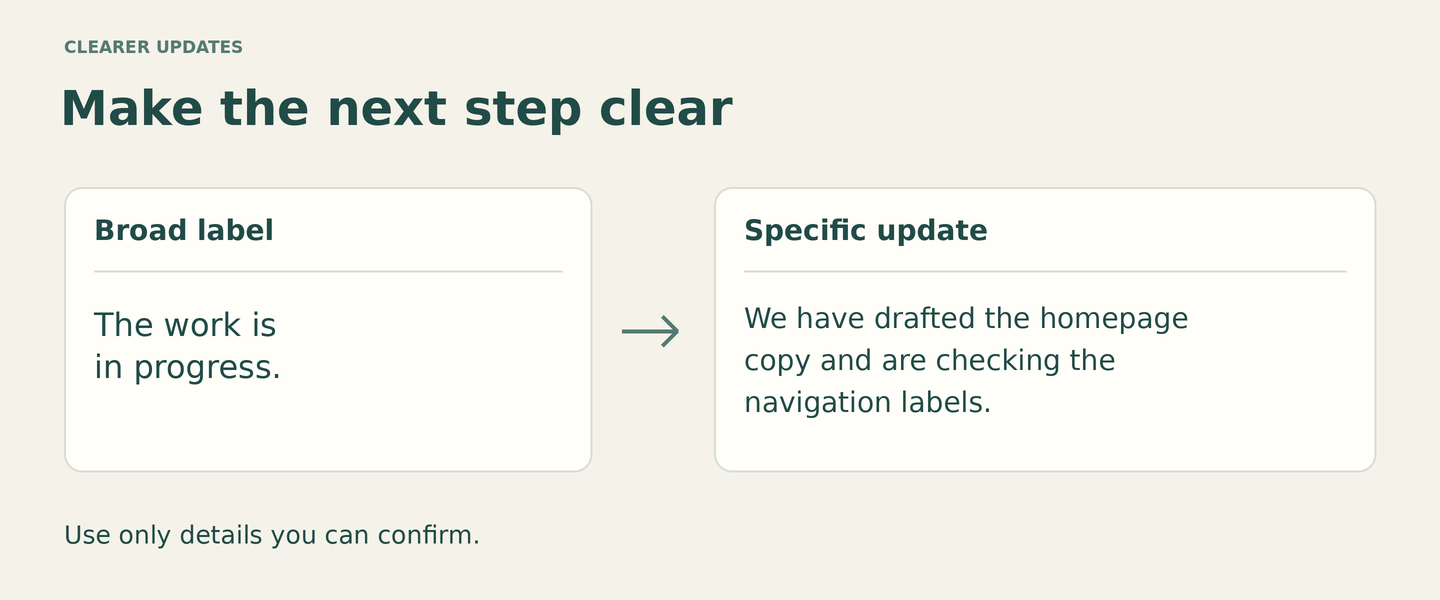
“The website project is in progress” is grammatical, but it leaves several questions unanswered. Is the team writing copy, checking accessibility, or waiting for approval? A useful update names the work already done and the next step.
Compare:
- Broad: “The work is in progress.”
- Specific: “We have drafted the homepage copy and are checking the navigation labels.”
- Blocked: “The draft is ready; we are waiting for the client’s approval.”
The blocked version is more informative than leaving the task marked “in progress” indefinitely. It explains why the work is not moving without inventing a completion date.
If your team uses “in process” as an official label, keep that label when referring to the dashboard. Then explain its meaning in plain language. Consistency with a local workflow helps colleagues interpret the update, but it does not create a universal English rule.
Choose “in progress” for a general summary. Choose “in process” when referring to the team’s defined category. Add an owner, next action, or confirmed deadline when those details matter.
What do “in process” and “in progress” mean on applications?
An application marked “in progress” or “in process” has a meaning defined by the organization using the label. The words alone cannot establish whether you will be accepted, rejected, interviewed, or asked for more information.
A status may cover several steps in a procedure rather than identify one exact stage in the workflow. An organization might use one label for a broad category rather than display every internal change. Do not assume that “in process” means a person is actively reading your application at that moment.
Likewise, “in progress” might refer to an application you are still filling out, or to an application the organization is considering. The surrounding instructions determine which reading fits.
Before interpreting a status, check:
- Whether you submitted the application successfully.
- Whether the portal explains its labels.
- Whether the organization requested any missing documents.
- Whether a published response window has passed.
“In process” does not guarantee approval. “In progress” does not guarantee rejection or a delay. Neither gives a dependable timetable without additional information.
If you write customer-facing labels yourself, choose wording such as “Awaiting documents” or “Under review” when that is the verified state. A specific label tells readers more than a broad status and reduces unnecessary follow-up questions.
Should orders use “in progress” or “in process”?
Orders can be described as “in progress” or “in process,” but a more specific status is usually more useful to customers. Tell them whether the order is being checked, prepared, packed, or dispatched when you know that information.
“Your order is being processed” describes handling by a business or its system. It does not necessarily mean the parcel has shipped. “Your order is in process” is similarly broad, even if it is the business’s official wording.
For payments, “The payment is being processed” is clearer than a bare “in process” label. Still, being processed is not the same as a confirmed successful payment. Use “Payment received” only when receipt is established.
The distinction between a general status and a completed action matters more than choosing the more formal-sounding phrase. If a customer needs a tracking number, replacing “in process” with “in progress” does not answer the question.
For a confirmation message, also check the correct spelling of received. Clear wording and accurate spelling help the reader understand what has actually happened.
Avoid adding a promised delivery date merely to make an update sound helpful. A precise statement about the known status is better than an unsupported assurance.
How does “in the process of” differ from “in progress”?
“In the process of” introduces an action or change that is underway. “In progress” usually gives a status without needing that additional description.
Compare these original examples:
- The archive move is in progress.
- We are in the process of moving the archive.
- The archive is being moved to another building.
The first focuses on the task. The second names the people responsible and their action. The third focuses on what is happening to the archive. Choose the structure that puts the important information first.
Collins explains “in the process of” as doing something already underway. Its American English entry also records “in (the) process of,” so omitting “the” should not be labeled universally ungrammatical. For a straightforward modern example, “We are in the process of moving” is a clear choice.
After “of,” use an appropriate noun or an -ing form: “in the process of relocation” or “in the process of relocating.” Do not write “in the process of relocate.”
“In the process” can also describe something occurring while another action takes place: “We reorganized the files and found an old photograph in the process.” That additional use should not be confused with a status label.
Is “work in process” the same as “work in progress”?
“Work in progress” commonly describes unfinished work, while “work in process” is an established specialist expression, including in manufacturing. The terms overlap, but the surrounding business vocabulary may give them a narrower meaning.
A novelist can call an unfinished manuscript a work in progress. A designer can say that a prototype is a work in progress. In both cases, the phrase identifies something that still needs attention before it is ready.
In a factory, work in process can refer to unfinished goods within production. Infor’s official glossary includes items being made and items waiting for further processing. That is a clear reason not to dismiss “work in process” as incorrect English.
The distinction does not support a universal rule that one expression always means short tasks and the other always means long tasks. Use the terminology defined by the relevant business, report, or accounting policy.
For a general audience, “unfinished goods” or “unfinished work” may be easier to understand. For a specialist audience, preserve the exact defined label. If a document uses WIP, spell it out on first mention so readers know which expression the abbreviation represents.
Can automated work be “in progress” rather than “in process”?
Yes. Automated work can be “in progress” because the phrase describes something happening, not who or what performs it. A computer operation does not need to be called “in process” simply because it is automatic.
“The backup is in progress” is a clear update about a running system. “The files are being processed” describes what the system is doing with the files. Both can be suitable descriptions of the same operation from different viewpoints.
The same principle applies to people. A person can follow a procedure, and a team can have several items in process. There is no dependable human-versus-machine division between these expressions.
Ask what your reader needs to know:
- Is an activity happening? “In progress” gives a broad answer.
- Is an item moving through a defined sequence? “In process” may fit.
- Is the system actively transforming data? “Being processed” names that action.
Choose the description supported by the facts. Do not label a queued task as actively running merely because a dashboard groups both conditions together. If the distinction matters, separate “Queued” from “Running” rather than trying to make the two expressions carry that difference alone.
How do you write “in-process” and “in-progress” modifiers?
“In-process” and “in-progress” can take hyphens when the two words function together before a noun. The hyphen helps show that they form one modifier.
Compare:
- The inspection occurs during production: an in-process inspection.
- The assignment is not yet complete: an in-progress assignment.
- The assignment is in progress.
- Several items remain in process.
The last two examples do not use the hyphen because the expressions follow the verb rather than directly precede a noun. A publication’s house style may guide borderline cases, so aim for clarity and consistency rather than adding punctuation mechanically.
You can often avoid an awkward compound by rewording. “Ongoing assignments” reads smoothly, and “assignments in progress” makes the status explicit. Neither requires a complicated grammar explanation for the reader.
Keep “in progress” as two words in ordinary writing. “Inprogress” is not the standard form. A software identifier or username may have its own spelling, but that does not change the spelling of the everyday expression.
Which alternatives to “in process” and “in progress” are clearer?
Alternatives are clearer when they tell readers exactly what is happening. “In progress” and “in process” are useful broad labels, but a precise verb can replace either one in an informative update.
| What you know | A clearer update |
|---|---|
| Someone is assessing the documents | Your documents are under review. |
| The team needs an answer | We are waiting for your approval. |
| Staff are preparing an order | We are packing your order. |
| A file operation is running | Your files are being processed. |
| A task cannot proceed | The task is paused until the replacement arrives. |
“Ongoing” and “underway” are useful alternatives for an activity in progress. “Being processed” often fits an item that a person or system is dealing with. “Under review” is appropriate only when assessment is the known state.
Do not replace one vague label with a more specific label unless the facts support it. An item in process is not necessarily approved. An item in progress is not necessarily nearly finished.
For someone designing a workflow, define each label in a short help note. Explain what the reader should do next and whether they need to take any action. That is more useful than asking a broad status to communicate every detail.
What mistakes occur with “in process” and “in progress”?
Common mistakes include using the wrong preposition for the intended status, treating overlapping expressions as strict opposites, and confusing a noun with a verb.
For a task happening now, use “in progress,” not “on progress.” However, “a report on progress” is grammatical because “on” means “about.” The full sentence determines whether the wording fits.
Similarly, “a discussion on the process” can be correct when the discussion concerns a procedure. It does not mean the discussion is currently underway. Avoid declaring every occurrence of “on process” wrong without checking the surrounding words.
“Make progress” and “follow a process” also have different jobs. You make progress when you move toward a goal. You follow a process when you carry out an established method. A task can involve both.
Finally, “progress” is also a verb: “The investigation progresses slowly.” That construction differs from “The investigation is in progress.” The first says something about development; the second reports status.
When editing a project update, ask whether your wording describes the action, the method, or the current state. Once you identify that purpose, the choice becomes easier.
Can you practice choosing “in process” and “in progress”?
Practice with context rather than treating “in process” and “in progress” as a pair with one universally right answer. Choose the wording that best communicates the facts provided.
- A sign outside an occupied conference room says: “Meeting ___.”
- An internal factory report uses a defined category for goods awaiting another operation: “Items ___.”
- Your team is changing offices: “We are ___ moving offices.”
- A colleague asks whether a draft is ready: “The draft is still a ___.”
- A computer is converting uploaded files: “The files are ___.”
- A portal displays “In process.” Does that prove the application has been approved?
Suggested answers
- In progress. The sign says that the event is happening now.
- In process. The report refers to the established category within that operation. Use its defined terminology.
- In the process of. This construction introduces what the team is doing.
- Work in progress. The draft still needs attention before it is ready.
- Being processed. This describes the operation performed on the files. “The conversion is in progress” also works.
- No. The label alone does not establish an outcome. Read the organization’s explanation.
The exercise tests meaning, not a trick distinction. If two answers appear possible, explain what each would emphasize. That explanation is often more useful than memorizing a rigid substitution rule.
What is the simplest rule for “in process” and “in progress”?
Use “in progress” as your default for general ongoing tasks. Use “in process” when an established procedure or specialist context makes that wording useful. Use “being processed” when you want to describe what is being done to an item.
A quick decision check keeps the choice practical:
- Describe what is happening, rather than assuming what a status implies.
- Keep the exact label when quoting a portal or internal system.
- Explain the next step if the reader needs more than a general update.
- Prefer a concrete verb when it communicates the situation more clearly.
“In progress” tells readers that an activity continues. “In process” can place an item within a procedure. Neither replaces the details that explain where things stand.